

A provision store runs on small margins and a fast counter
Rice, oil, milk, soap and a queue that never really ends. Here is what goes wrong in a provision store, and how to keep the figures honest without slowing the counter down.
A provision store is a volume business in a small shop's clothes. Forty to sixty sales a day, most of them small, on goods that earn a few cedis each. That is not fragile on its own. It becomes fragile because the buying price moves and the shelf price does not. The bag of rice you sell at GH₵ 145.00 was bought at one price in January and another in July, and unless somebody changes the shelf price the same week the market changes, the shop spends a fortnight selling at last season's margin and calling it a good month.
The second thing is that a provision store is the shop where credit is hardest to refuse. Your customers are your neighbours. Somebody takes a tin of milk and half a bag of rice and says they will bring it on Friday, and there is no version of that conversation where you say no. Twenty of those a month, held in a book and in memory, becomes an argument by month end. Written down once, at the counter, against a name, it becomes a number instead.
None of this is a failure of the exercise book. The book is fast, it never runs out of battery, and it has been the shop's memory for years. What it cannot do is add itself up, tell you which of two hundred lines actually earned anything, or answer at nine in the evening whether the sale you are arguing about was recorded. That is the only gap worth closing.
What usually goes wrong
The margin moves and nobody notices
Staples are priced by the market, not by you. When your supplier's price goes up, the price on your shelf has to move the same week or the difference comes out of your own money, one bag at a time, for as long as it takes somebody to notice.
The counter cannot stop for a phone
Five people waiting at half past six will not wait for a page to load. Anything that needs a second screen or a spinner gets abandoned by the third customer, and then the day is only half recorded, which is worse than not recorded at all.
The book fills with neighbours
Small credit, many names, most of it remembered rather than written. The disputes are never about big money. They are about the twenty cedis from three weeks ago that both of you half remember, and they cost you the customer either way.
The cash never matches
Money leaves the box all day for things that are not sales: the tricycle from Makola, the boy who carried the bags, change borrowed and put back. Unless those land somewhere, the evening count is a guess, and an honest shortage looks exactly like theft.
The parts a provision store actually uses
Selling, restocking, the daily close and money out are on every plan, including the one that costs nothing. Credit and more than one selling unit per product begin at Shop.
The whole sale on one screen
Search, quantity, price and payment sit on one screen, so a three-line cash sale never changes the page under a queue. Cash and MoMo are on every plan; selling on credit is part of Shop.
Restock the way the market writes it
Enter what came off the tricycle and what you paid for it. The app adds it to that branch's stock and works out your new average cost. What you paid now and what is still owed are entered separately and can never disagree with the total.
Your lowest price rises with your cost
You set the lowest price you will accept on a product. When a restock pushes your average cost above it, the app raises it and tells you it did, so last season's price cannot quietly become this season's loss.
Tin, pack or carton
One product can carry several selling units, each with its own price, while the shelf stays counted in one base unit. Sell a carton of forty and the count drops by forty. More than one selling unit per product is part of Shop.
A daily close on every plan
Sales and money split into cash, MoMo and credit, with returns, money out and the cash you should be holding. One figure to count the box against, on every plan including Start.
Money out, so profit is the real one
The transport, the carrier, the small repair. Recorded against a category and, when paid in cash, taken off the cash the app expects you to be holding this evening. On every plan.
Stock and the market run
Leave for Makola with a list, not a memory
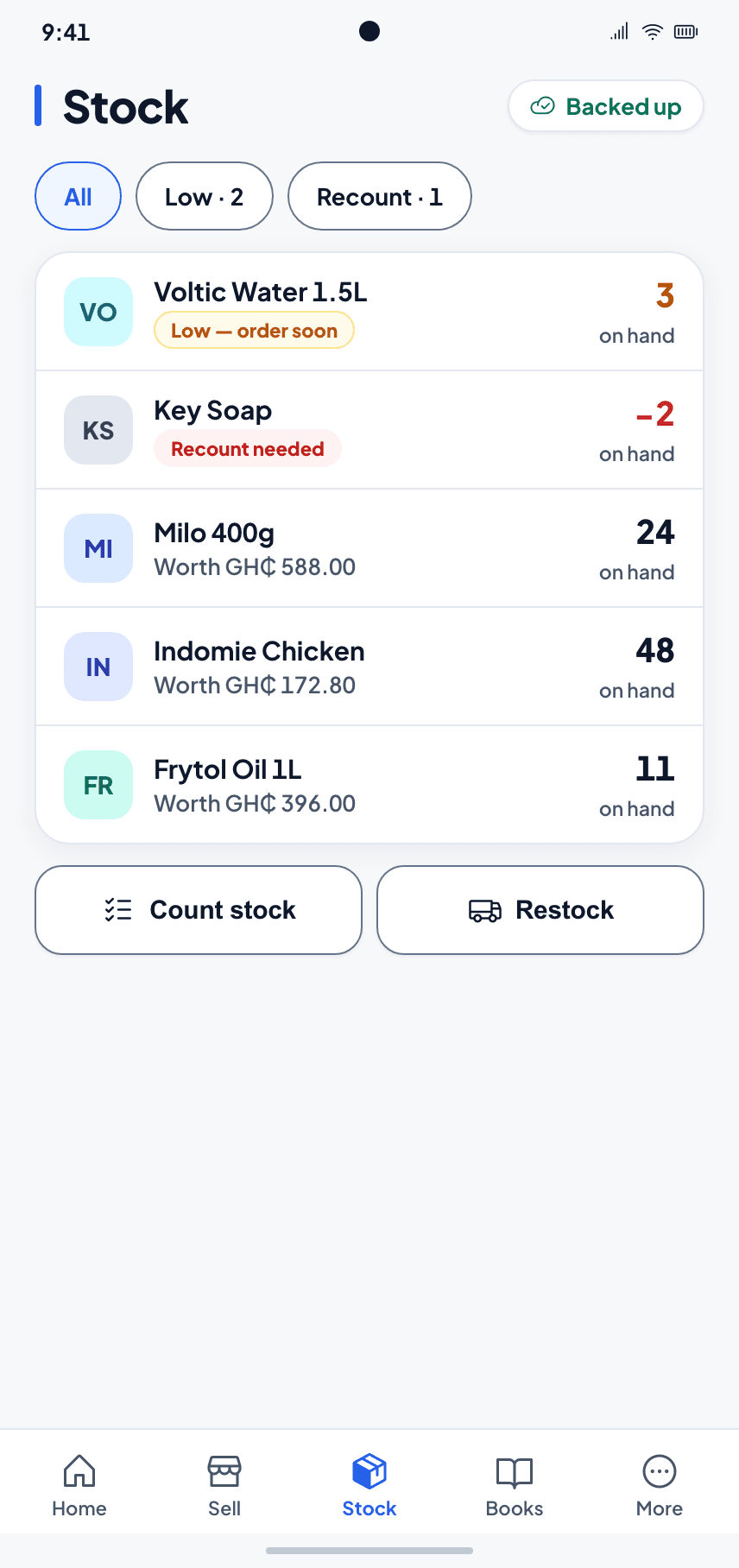
The shelf count moves down as you sell and up as you restock, and marks what is running low and what needs a recount. What you take to the market stops being a guess made at the door.
- Low is a number you chooseGive a product a low mark and it badges itself when it drops there, and appears in the evening summary.
- A sale is never blocked by the countIf the app thinks a shelf is empty and it is not, the sale still goes through and the product is marked for a recount. Nobody argues with a customer about what a phone thinks.
- Count without seeing the answerA count hides the app's own figure while you work, then shows book against shelf and books the difference in one tap, with a reason.
- Cost stays yoursStaff see how many are on the shelf. What you paid, and what each sale earned, sit in owner-only records that never reach their phone.
A Tuesday at Adjoa's Provisions, Madina
One ordinary day, from the tricycle in the morning to counting the box at night. Every figure below is worked out by the app, not by you.
Step 1
Half past seven: the tricycle from Makola
Twenty tins of Milo 400g come off the tricycle at GH₵ 25.50 each. You paid GH₵ 300.00 by MoMo at the market and the rest is owed to Melcom Distribution. You enter the lines and what you paid; the app works out what is still owed and will not let those two figures disagree with the total.
20 × Milo 400g at GH₵ 25.50GH₵ 510.00Paid now, MoMoGH₵ 300.00Still owed to Melcom DistributionGH₵ 210.00Step 2
Your average cost moves, so your lowest price moves
You already had ten tins that cost you GH₵ 24.00 each. Now you hold thirty at an average of GH₵ 25.00. Nothing you sold last week is rewritten: every sale keeps the cost it had on the day. But if the lowest price you had set on Milo was under the new average, the app raises it and tells you why. That one sentence is worth more to a provision store than any report.
10 tins already on the shelf, at GH₵ 24.00GH₵ 240.0020 tins received, at GH₵ 25.50GH₵ 510.00New average cost, per tinGH₵ 25.00Step 3
GH₵ 150.00 to the tricycle is not a sale
Record it as money out under Transport, paid in cash. It comes straight off the cash the app expects you to be holding this evening, which is the only reason the evening count ever matches. Money that leaves the box without a record is the single most common reason a shop believes it is being robbed.
Step 4
Twenty past four: half cash, half in the book
A customer takes Rice 5kg (Royal Aroma) and Cooking Oil 5L (Frytol). She has GH₵ 300.00 in cash and asks you to put the rest on her name. That is one sale with two payment rows, not two sales, and it prints as one receipt: MAD-D02-000318. Selling on credit is part of Shop.
Rice 5kg (Royal Aroma)GH₵ 145.00Cooking Oil 5L (Frytol)GH₵ 185.00TotalGH₵ 330.00CashGH₵ 300.00On her name, in the bookGH₵ 30.00Step 5
Half past eight: the close
The day's figures for Madina arrive on your phone: how many sales and how much, split into cash, MoMo and credit, the returns, the money out, and the cash you should be holding. You count the box against one number. When it is short you are looking for one thing, not for the whole day.
Nothing in that day needed a network, and nothing in it was written twice. Every figure was recorded once, by the person who was standing there when it happened.
Which plan this shop needs
Every shop starts on the same plan. What differs is where each one runs out.
- Where you begin
- Start costs nothing and has no time limit. For a provision store it covers the counter properly: cash and MoMo sales, receipts, returns, stock counts, the daily close and money out, all with no network.
- Where this shop runs out
- 20 products. A provision store carries somewhere between fifty and three hundred lines, so Start usually runs out on the first afternoon of typing in the shelf. Selling on credit and putting a salesperson on their own phone also begin at Shop.
- The plan that fits: Shop
- Shop at GH₵ 50.00 a month is the shape of a provision store: 500 products, the credit book, several selling units per product, and staff on their own phones (Owner + 2).
- What moves you up later
- Growth at GH₵ 125.00 a month is the plan for the day Kaneshie opens: 1 included, up to 3, unlimited products, profit by product, and the value of the stock standing on your shelves.
Questions this shop asks
Can I run a provision store on the plan that costs nothing?
For a while, yes. Start covers cash and MoMo sales, receipts, returns, stock counts, the daily close and money out with no network, for one shop and the owner alone. It stops at 20 products, and most provision stores carry more than that, so the shelf itself is usually what moves a shop to Shop.
Does it handle the same product in a tin and a carton?
Yes. One product can carry several selling units, each with its own price and its own lowest acceptable price, while the shelf stays counted in one base unit. Sell a carton of forty and the count drops by forty, not by one. More than one selling unit per product is part of Shop.
What happens when my supplier raises the price?
You record the delivery at the new cost and the app works out your new average cost for that branch. If the lowest price you had set on that product now sits below what it costs you, the app raises it and tells you it did. Sales you already recorded keep the cost they had on the day, so last week's profit is never rewritten.
Keep reading
Running a shop without the exercise book
What to move off paper first, and what to leave exactly where it is.
What your profit actually is
Takings are not profit. Here is the subtraction most shops never do.
Selling when the network is down
Keeping the counter moving through a dead spot or a power cut.
AxisTrade and the exercise book, side by side
What the book does better, and the four things it cannot do at all.
Shops like yours

Get AxisTrade
Download it on Google Play or the App Store, add your products, and record your first sale today.
Your records are yours. Saved on your phone. Backed up safely. Never shared, never sold.
Send SHOP and we will help you get your shop set up.