

A cosmetics kiosk keeps most of its money on the shelf
Creams, relaxers, perfumes and hair food: fewer sales a day, bigger ones, and regulars who settle at month end. The risk in this shop is not the counter. It is the stock that stops moving and the book that gets argued with.
A provision store turns its money over every week. A cosmetics kiosk does not. One shelf can hold more money than the shop takes in a fortnight, because the lines that carry the margin are the slow ones: the imported cream somebody asks for twice a month, the perfume that sits until December. That is not bad buying, it is the business. But it means the important question in a cosmetics kiosk is never how much you sold today. It is which of these things has not moved since March, and how much of your money is standing in it.
The second thing is the book. Cosmetics is a repeat trade with a small circle: the same women come back every month, they know you, and they buy on credit far more often than a passing customer would. That circle is worth protecting, which is exactly why the record has to be one nobody can argue with. A customer who genuinely forgot she paid GH₵ 50.00 in April is not a thief. She is a customer you will lose if the only answer you have is that you remember it differently.
And a kiosk grows lines faster than it grows sales. One cream in three sizes and two shades is five things to count, five prices to keep straight, and five things that run out separately. In a book that is five more rows a week. On the shelf it is the difference between telling a customer you have it and telling her you have it in the shade she wants.
What usually goes wrong
Money sleeps on the shelf
The slow, expensive lines are where the margin is and where the cash is trapped. Without a figure for what is standing on the shelf, and which lines have not moved in months, buying is done from feeling and the feeling is usually optimistic.
Regulars buy on credit and settle late
A small circle, a long memory, and no record. The month-end conversation is the whole relationship, and it should not depend on which of you remembers better.
Shades and sizes multiply
The same cream in three sizes is three things to count and three prices to hold. A single line called cream is a line you can never count, and a shop that cannot count cannot tell shrinkage from a good week.
Small, expensive things walk
One item at a time, from a counter people lean on. It never announces itself. It shows up as a shelf that does not match the book, months after anybody could say what happened.
The parts a cosmetics kiosk actually uses
The counter, stock counts and the daily close are on every plan. The credit book and customer limits begin at Shop; what your shelf is worth and what each line earns are part of Growth.
The credit book, in her name
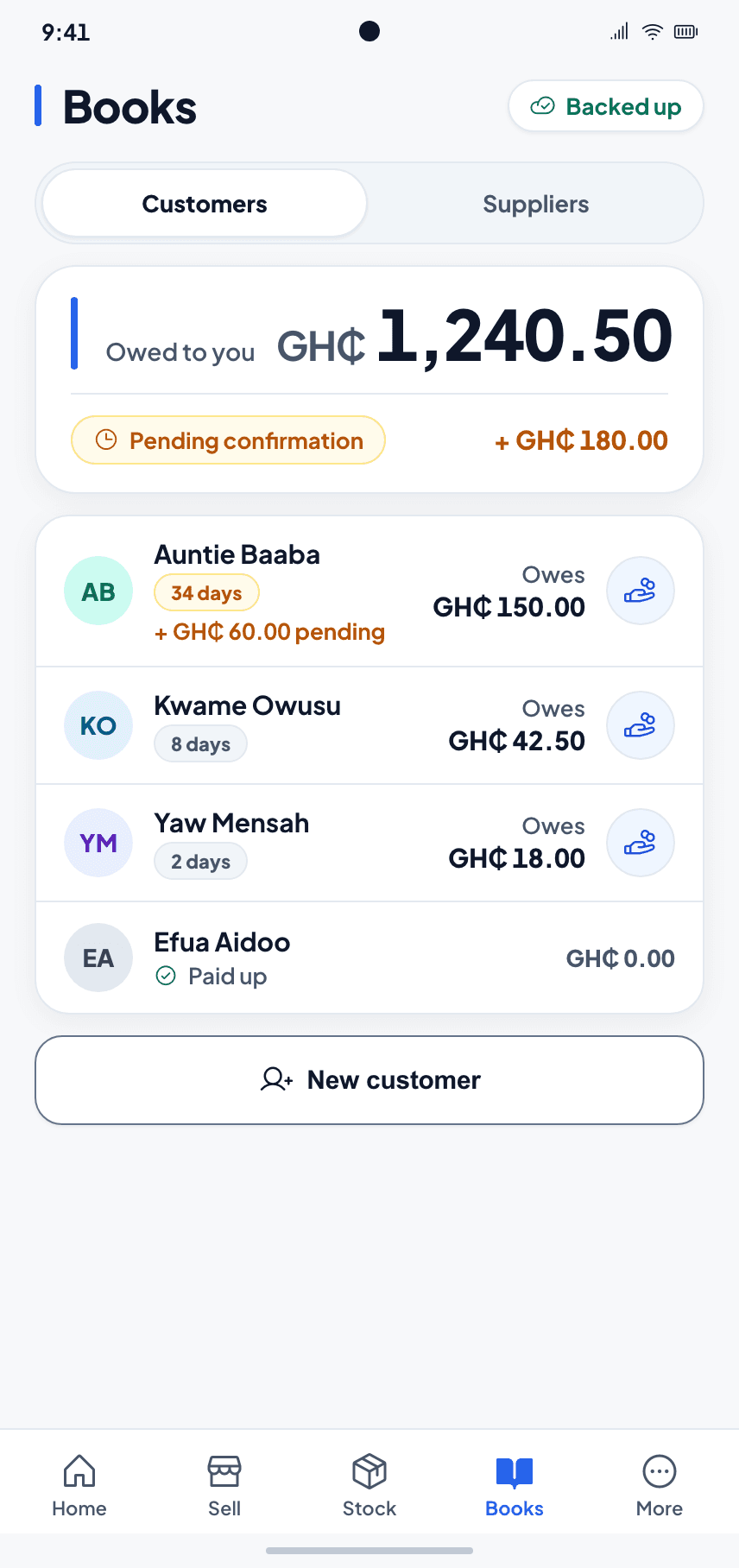
Every credit sale, repayment and return is an entry nobody edits, so the figure beside a name is simply what she owes. The app does the adding. Part of Shop.
Her own record, on WhatsApp
When a regular disputes a figure, share her statement: every sale and every repayment, dated. AxisTrade does not send it for you. You send it, from WhatsApp, which is why it never goes out behind your back.
A ceiling for each customer
Give a customer a limit and the phone shows it, with what she already owes, before you agree to the next one. A sale made with no network that goes past the limit is still recorded, then raised for you to decide on.
Counting without fooling yourself
A count hides the app's own figure while you work. You write what is on the shelf, then see book against shelf and book the difference with a reason: damaged, expired, theft, count.
What actually moves
Sales by product over a week or a month separates the shades that sell from the ones standing since the rains. Part of Shop.
What the shelf is worth
Stock value gives you the money tied up in what you are holding, per branch, and profit by product tells you which of the slow lines earn enough to deserve the space. Both are part of Growth.
The credit book
The month-end conversation, settled in ten seconds
A kiosk lives on regulars, and regulars buy on credit. The whole point of writing it down is that nobody has to be believed: the record is the record, and it was made in front of both of you.
- Settled and pending never mergeWhat is confirmed and what is still waiting to be backed up stay two separate lines, never one figure you might chase by mistake.
- Oldest firstWho owes you, and for how long, so you follow up on the one that has been sitting since April rather than the one you happened to see yesterday.
- Repayments work with no networkHalf, all, or a typed amount, recorded at the counter in seconds, whether or not there are bars on the phone.
- Collecting is never blockedEven back on Start, you can still record money someone already owes you. The book goes read-only. It does not go away.
Akosua Mensah, a regular
One customer, one month, and the two places a kiosk normally loses money: the book and the shelf.
Step 1
She has a ceiling, and you can both see it
Akosua is on the book with a limit of GH₵ 200.00 and a balance of GH₵ 150.00. When she asks for something else on credit, the phone shows you both figures before you agree. Nothing about that is a judgement of her. It is simply the number, in front of the two of you, which is what makes it easy to say.
Credit limitGH₵ 200.00Owed todayGH₵ 150.00Room leftGH₵ 50.00Step 2
Month end: she pays GH₵ 50.00 by MoMo
You record the repayment at the counter, as half, all or a typed amount. The book now says GH₵ 100.00. There is nothing to add up and nothing to cross out, and the entry can never be edited later by anyone, including you.
Balance beforeGH₵ 150.00Repayment, MoMoGH₵ 50.00Owed nowGH₵ 100.00Step 3
The sale you made with no network stays separate
A GH₵ 60.00 credit sale recorded while the network was gone sits on its own line, pending confirmation, until the phone has backed up. It is never quietly folded into what she owes, because you should not chase a figure that is not yet settled.
OwedGH₵ 100.00Pending confirmationGH₵ 60.00Step 4
If she disputes it
Share her statement to WhatsApp: every sale, every repayment, dated, in her name. That is usually the end of the conversation, and it ends it without anybody being called a liar. It is also the reason regulars keep buying on credit from a shop that writes things down.
Step 5
The shelf, once a month
Count your twenty biggest lines on a quiet Sunday, with the app's own figure hidden while you work. When you finish it shows book against shelf and you book the difference in one tap, with a reason. Expired is a different problem from theft, and three months of reasons tells you which one you actually have.
Two of those five steps are the entire reason a cosmetics kiosk keeps a book at all. The other three are what turns the shelf from a feeling into a figure.
Which plan this shop needs
Every shop starts on the same plan. What differs is where each one runs out.
- Where you begin
- Start, at no cost and with no time limit, covers a kiosk that sells for cash: the counter, receipts, returns, stock counts, the daily close and money out, all with no network.
- Where this shop runs out
- Credit. A kiosk that lets its regulars settle at month end needs customer records, limits and a ledger, and those begin at Shop. 20 products also runs thin fast, because one cream in three sizes is three lines.
- The plan that fits: Shop
- Shop at GH₵ 50.00 a month matches how a kiosk actually trades: 500 products, the credit book with limits and shareable statements, sales by product, and room for help at the counter (Owner + 2).
- What moves you up later
- Growth at GH₵ 125.00 a month answers the question a kiosk asks and a provision store does not: what is standing on my shelf, and which of my slow lines is earning its space. Stock value and profit by product are part of Growth.
Questions this shop asks
Can I set a limit on how much a customer takes on credit?
Yes, from Shop. Each customer can carry a ceiling, and the phone shows it beside what they already owe before you agree to the next sale. If a sale recorded with no network takes them past it, the sale is still kept, because the goods left the shop, and it is raised for you to decide on afterwards.
What if a customer says she already paid?
Open her record and share the statement to WhatsApp: every sale, every repayment, dated, in her name. Nothing in it can be edited by you or by anyone else, and corrections are added as new entries rather than changing old ones, which is what makes it worth showing her.
How do I handle the same cream in three sizes?
Two different ways, and the right one depends on the goods. A carton and a single of the same item are one product with two selling units, which is part of Shop. Two different sizes or two different shades are two different products, because they are two different things to count. Start holds 20 products in all; Shop holds 500.
Keep reading
Keeping the credit book straight
How to give credit without losing the customer or the money.
Counting stock without fooling yourself
Why counting with the book open in front of you proves nothing.
What your profit actually is
Slow, expensive stock hides the answer. Here is how to get it.
AxisTrade and the exercise book, side by side
What the book does better, and the four things it cannot do at all.
Shops like yours

Get AxisTrade
Download it on Google Play or the App Store, add your products, and record your first sale today.
Your records are yours. Saved on your phone. Backed up safely. Never shared, never sold.
Send SHOP and we will help you get your shop set up.