

A drink depot sells by the crate and buys on credit
Water and minerals moving in packs and crates, sold to chop bars and small shops that settle on Friday, bought from a van that expects settling next week. Two books, both of them large, and the empties on top.
A depot is the only one of these shops where the money you owe is as large as the money you are owed. The van drops stock and you settle later; the chop bar down the road takes six packs and settles on Friday. In a good week both of those are fine. In a bad week you are holding somebody else's stock, waiting on somebody else's money, and the only record of either is a conversation you half remember.
The second thing that makes a depot different is that one product is three products depending on who is buying. A pack of fifteen at GH₵ 48.00 is one price to a customer taking one pack and a different price to a chop bar taking ten. Price the pack like a single and you hand over the margin. Count the pack as one item and your shelf figure stops meaning anything by Wednesday.
Then there are the empties. Crates and bottles come back, the deposit sits between you and the customer, and none of it ever appears in a sales figure. Be clear about this one: AxisTrade does not keep a deposit book and does not track returnable crates or bottles. That tally is one number a day and paper handles it perfectly well. What paper cannot do is add up the other two books, which are the ones that get argued about.
What usually goes wrong
Two books, both of them big
What the chop bars owe you and what you owe the van are roughly the same size. Only one of them normally gets written down, and it is usually not the one that is about to arrive at your gate.
One product, three prices
A single, a pack and a crate are one thing on the shelf and three things at the counter. Selling the crate at the pack price is how a depot gives away a week of margin in an afternoon and never sees it happen.
Counting in the wrong unit
If a pack of fifteen counts as one, your shelf figure and your actual bottles part company immediately, and every count after that is a fresh argument with yourself.
Thin margins, large numbers
A couple of cedis a crate across two hundred crates is the whole week's earnings. At that scale you cannot find your mistakes by feel, because the mistake and the profit are the same size.
The parts a drink depot actually uses
The counter, returns, the daily close and money out are on every plan. Several selling units per product, the credit book and what you owe your suppliers begin at Shop.
Single, pack and crate, one count
One product carries as many selling units as it really has, each with its own price and its own lowest acceptable price, while the shelf stays counted in one base unit. More than one selling unit per product is part of Shop.
What you paid, and what you still owe
Record the drop with what you paid on the spot and how. What is still owed is worked out for you, and the two figures can never disagree with the total. Recording an owed balance is part of Shop.
Who you owe, oldest first
Every supplier's running balance, with how old it is, and a statement you can share when you sit down to settle. Part of Shop.
Who owes you, and for how long
The chop bars and small shops buying from you get the same treatment: an entry per sale, an entry per repayment, and nobody edits either one. Part of Shop.
Cash expected, every evening
Sales split into cash, MoMo and credit, less the cash that went out for fuel and the carrier, gives one figure to count the box against. On every plan.
Returns against the original sale
A pack that comes back is refunded at the price actually paid on that sale, and goes back into the count in the exact quantity it left. Not a guess, and never twice.
Two books, one phone
Know what you owe before the van arrives
A depot's whole risk is timing: money out to the supplier, money in from customers who settle on their own schedule. Both books are add-only, so the figure beside a name is what is owed, not what somebody remembers.
- Nothing is edited outEvery sale, repayment and return is an entry. Corrections are new entries, so the history still stands afterwards.
- Settled and pending stay apartA credit sale recorded with no network shows as pending confirmation until the phone has backed up, and is never merged into the settled figure.
- Statements both waysSend a customer their record before Friday, and take the supplier's statement with you when you go to settle.
- Cost stays yoursSomeone can receive a delivery for you without ever seeing what the depot pays across the rest of the yard.
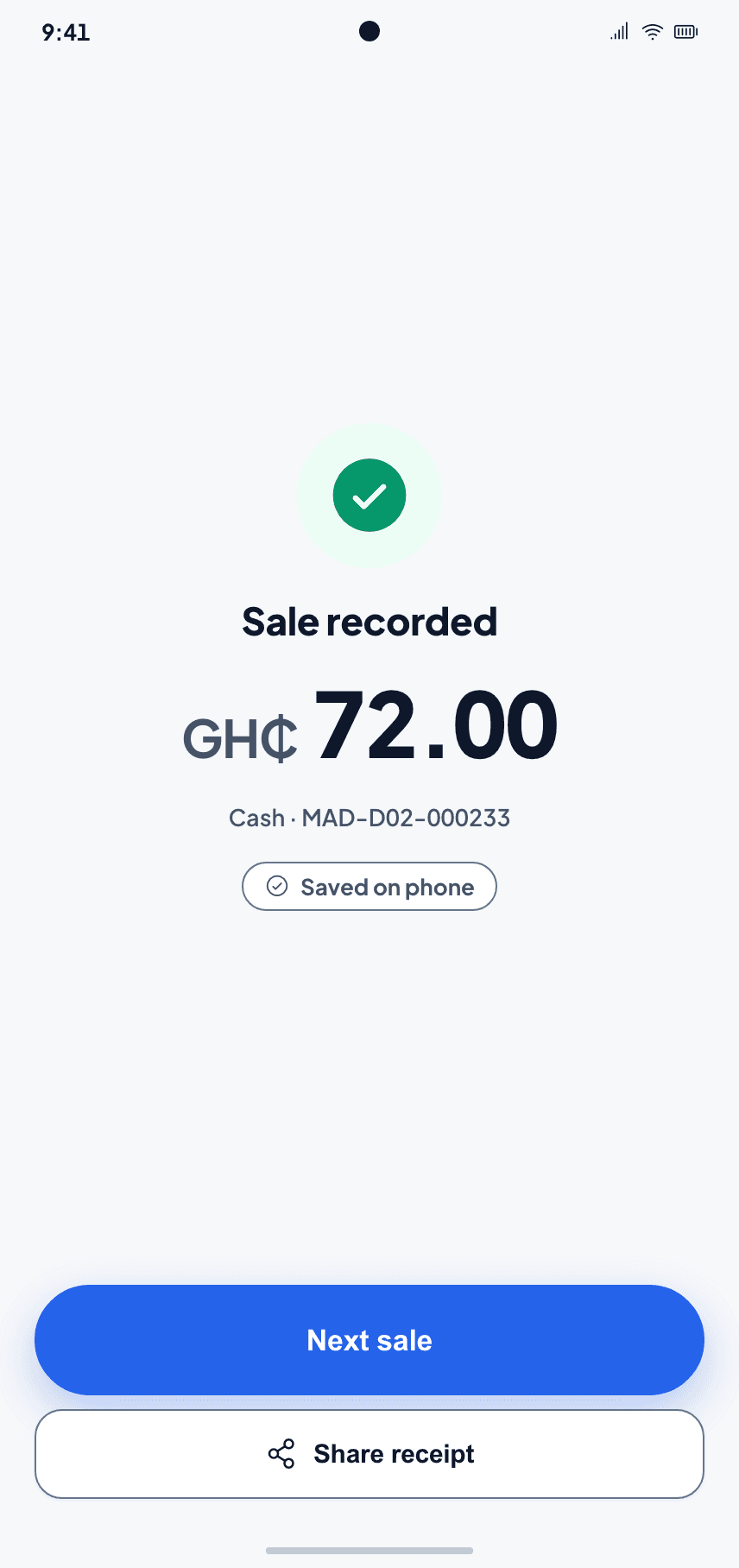
A Friday at the depot
One customer settling, one supplier waiting, and the shelf counted in bottles rather than packs.
Step 1
The chop bar takes 6 packs
6 packs of Voltic at GH₵ 48.00. They pay part by MoMo and the rest goes on their name: one sale with two payment rows, not two sales. The shelf drops by 90 bottles rather than by 6, because the pack is how you sell and the bottle is what you count.
6 packs at GH₵ 48.00GH₵ 288.00MoMo nowGH₵ 200.00On the bookGH₵ 88.00Bottles off the shelf90Step 2
The van is coming and you owe it
Last week's drop left GH₵ 210.00 still owed to Melcom Distribution. It sits on the same screen as everything else you owe, oldest first, so settling becomes a decision you make rather than a surprise that arrives.
Owed to Melcom DistributionGH₵ 210.00Step 3
Money out is not a sale
The GH₵ 150.00 for the tricycle and the fuel is money out, recorded under Transport. Paid in cash, it comes off the cash the app expects you to be holding at close, which is the only way the evening count and the box ever agree.
Step 4
Friday evening: the chop bar settles
They bring GH₵ 88.00 and the book goes to nothing. Recorded at the counter in seconds, with no network if that is how the evening goes, and the entry stands whether or not anybody remembers it next month.
OwedGH₵ 88.00RepaymentGH₵ 88.00Owed nowGH₵ 0.00Step 5
The empties stay on paper
AxisTrade does not track returnable crates, bottles, or the deposits you hold against them. Keep that tally where you keep it now. It is one number a day, it has never been the part that got argued about, and pretending an app handles it would only give you two records that disagree.
The part that gets argued about is the GH₵ 88.00, and that one is now a record instead of a memory.
Which plan this shop needs
Every shop starts on the same plan. What differs is where each one runs out.
- Where you begin
- Start covers a depot's counter for cash and MoMo, with receipts, returns, stock counts, the daily close and money out, all with no network and at no cost.
- Where this shop runs out
- One selling unit per product. A depot that sells the single, the pack and the crate needs more than one, and that begins at Shop, as do recording what you still owe a supplier and what a customer owes you.
- The plan that fits: Shop
- Shop at GH₵ 50.00 a month is the smallest plan a depot can honestly run on: several selling units per product, the credit book, what you owe your suppliers with a statement to settle against, and help at the counter (Owner + 2).
- What moves you up later
- Growth at GH₵ 125.00 a month matters when a second depot opens (1 included, up to 3) or when two cedis a crate stops being something you can estimate. Profit by product and the value of the stock in the yard are part of Growth.
Questions this shop asks
Does it track empties and crate deposits?
No. AxisTrade records the sale, the stock and the money, and it has no deposit book for returnable crates or bottles. Keep that tally the way you keep it now, and use the app for the two books that actually get argued about: what customers owe you and what you owe your suppliers.
Can I price the pack and the single differently?
Yes. One product carries several selling units, each with its own price and its own lowest acceptable price, and the shelf stays counted in one base unit, so a pack of fifteen takes fifteen off the count. More than one selling unit per product is part of Shop.
Can I see what I owe my suppliers?
Yes, from Shop. Every supplier carries a running balance built from entries nobody can edit, grouped by how old it is, with a statement you can share when you sit down to settle. What you owe is owner-only: someone who receives a delivery for you never sees it.
Keep reading
Keeping the credit book straight
How to give credit without losing the customer or the money.
Pricing when customers haggle
Setting a floor per unit, so the crate is never sold at pack money.
What your profit actually is
Thin margins on big numbers: the subtraction that finds them.
Shops like yours

Get AxisTrade
Download it on Google Play or the App Store, add your products, and record your first sale today.
Your records are yours. Saved on your phone. Backed up safely. Never shared, never sold.
Send SHOP and we will help you get your shop set up.