

A phone-accessory stall lives on hundreds of small lines
Cables, cases, chargers, earphones, screen protectors and memory cards: every one of them cheap, every one of them negotiable, and every one of them small enough to disappear. Price discipline and counting are the whole business.
The arithmetic of an accessory stall is unusual. A provision store has few enough lines to hold in your head and a margin set by the market. A stall has the opposite: three or four hundred lines, most of them worth less than the customer's lunch, and a price that is decided fresh at every sale. Nothing carries a printed price. What a cable sells for depends on the customer, the hour, and whether the person minding the stall felt like arguing.
That is not a problem to be solved. Haggling is how a market works, and a stall that will not bargain does not sell. The problem is that when every price is negotiable and somebody else is minding the counter, you have no way of knowing whether today's takings came from selling well or from selling everything at nearly cost. Two people can move the same goods and hand you a difference of several hundred cedis at the end of a week, and neither of them is stealing.
The other half is counting. Nobody counts four hundred lines, so what actually happens is that nothing is counted, and shrinkage is discovered as a feeling. The feeling is usually about a person, and it is usually unfair, because nobody wrote anything down when it would have been cheap to do so.
What usually goes wrong
Every price is decided at the counter
There is no list price on a cable. Whatever the person selling agrees to is the price, and unless something holds a line under them, your margin is whatever they felt like that morning.
Hundreds of lines, none of them named properly
Cable is not a product. A one-metre USB-C cable is. A stall that never made that distinction cannot count anything, because there is nothing for the count to attach to.
Small things walk
One item at a time, from an open tray, in a market. It never looks like theft on any single day, which is exactly why it goes on for months.
You are not always there
You are at the wholesaler, or minding a second stall. You need to know what left, at what price, and who sold it, without standing over anybody.
The parts an accessory stall actually uses
Floors, fast search and stock counts are on every plan, including the one that costs nothing. Staff on their own phones begin at Shop.
Bargain, but never under your line
You set the lowest price you will take on each product. The keypad refuses anything below it and shows only that lowest price, never what you paid. There is no override, not even for the owner.
A second wall under the first
Even if you forgot to raise a floor after cables got dearer, a second check refuses any line priced under what the product actually costs you on average. A stale floor cannot make you sell at a loss.
Found in two or three letters
Type the first few letters and matching lines come up as you type, from a shelf of hundreds, scoped to that branch. On the same screen as the rest of the sale.
Above your price is allowed too
If somebody pays over the price you listed, the app takes it with a quiet confirm instead of an argument. Keeping the change is recorded honestly rather than disappearing.
Count twenty lines, not four hundred
A count can be scoped to your biggest movers, to whatever is low or showing negative, or to a handful you pick, and it saves as you go. Thirty lines on a Friday is a habit you can actually keep.
Their own sign-in, their own sales
Everyone selling has their own number and passcode. They see their own sales; you see the whole branch, and every receipt number carries the phone that made it. Staff on their own phones begin at Shop.
Selling in a market
The network drops. The stall does not.
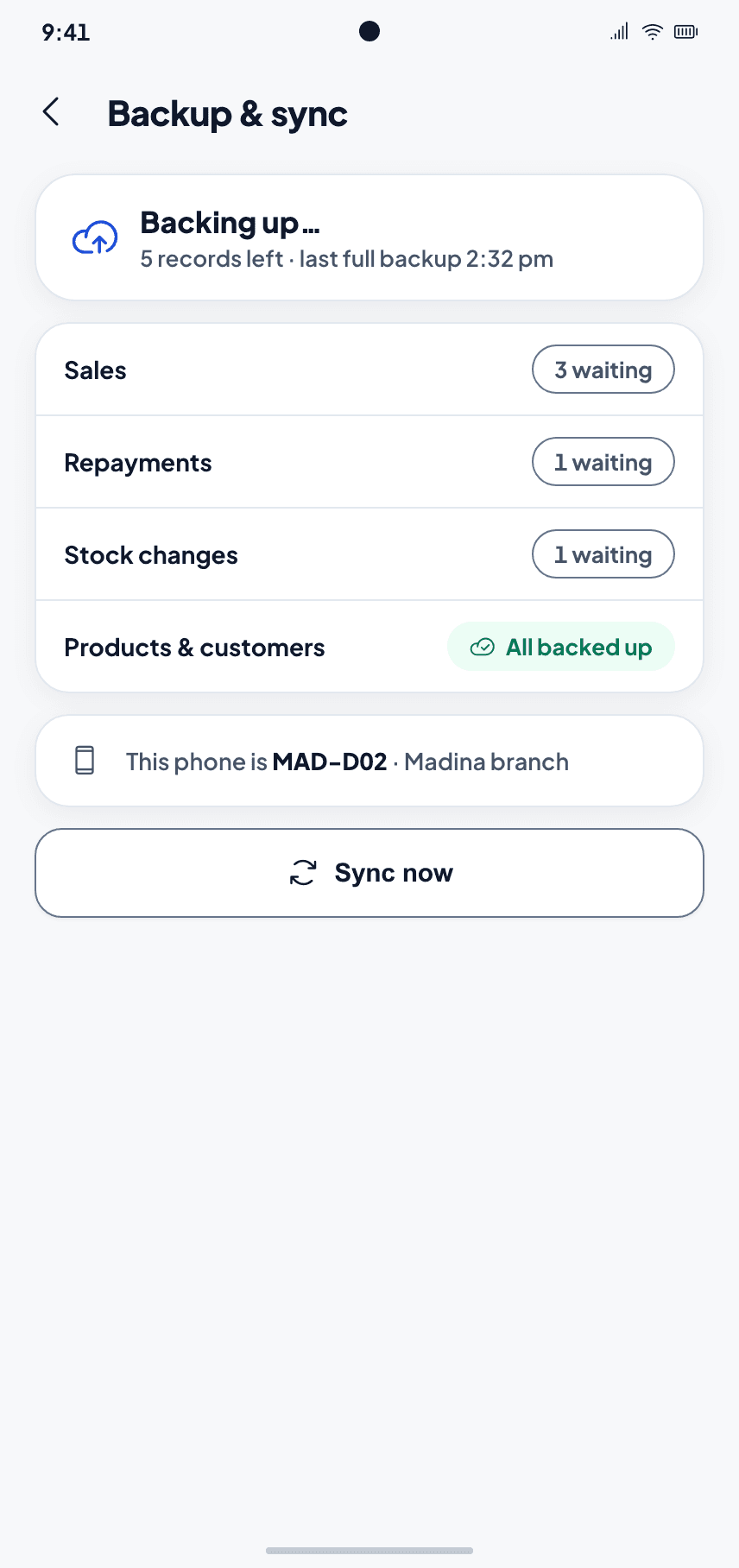
A market is concrete and dead spots, and a data bundle is somebody's own money. Every sale is recorded on the phone the moment it happens and backs up on its own later. Nothing waits for bars.
- Recorded on the phone firstNo spinner between the customer and the sale. The record is written on the phone and the receipt can be shared straight away.
- The same sale can never land twiceEvery record carries its own key, so a retry after a dropped connection cannot double your day's takings.
- Every record says where it standsSaved on this phone, backing up, backed up. You can see which phone is still holding work, and how much of it.
- Two phones on one stallYou and your attendant can both sell all afternoon with no network. Receipt numbers carry the phone that made them, so they never collide.
One line, one week
The figures below are the stall owner's own, not AxisTrade's: what a cable costs you, what you would like for it, and the lowest you will take. Everything after that is arithmetic.
Step 1
You set two numbers, once
The price you would like and the lowest you will accept. Say GH₵ 20.00 and GH₵ 15.00 on a one-metre cable that cost you GH₵ 9.00. The cost is yours alone: it lives in owner-only records that never reach the phone of whoever is minding the stall.
Price you listGH₵ 20.00Lowest you will takeGH₵ 15.00What it cost you, owner onlyGH₵ 9.00Step 2
The customer pushes
He offers GH₵ 12.00. Your attendant types it and the keypad refuses, showing GH₵ 15.00 as the lowest acceptable price. It never shows him the GH₵ 9.00. He can still sell at the floor, and often will, and you have lost nothing you were not already willing to lose.
Step 3
60 cables later
Over a week the stall moves 60 of them and the prices land wherever haggling lands them. With a floor, the worst week you can have is 60 at GH₵ 15.00. Without one, somebody who simply wants the sale finishes the same week nearer GH₵ 12.00. Same goods, same customers, same hours.
60 cables at GH₵ 15.00GH₵ 900.0060 cables at GH₵ 12.00GH₵ 720.00The difference, one line, one weekGH₵ 180.00Step 4
Friday: count twenty lines
Not four hundred. The biggest movers, with the app's own figure hidden while you count. The book says thirty-four screen protectors and the shelf has twenty-nine. You book the difference with the reason count, and it takes one tap. Next Friday you do it again.
What the book says34What is on the shelf29Difference−5Step 5
After a month you have a pattern
Five here, three there, always the same two lines, often the same day of the week. That is a completely different conversation from telling somebody you think they are stealing, and it is a fair one, because it is about a number that was written down at the time.
Neither habit, a floor and a Friday count, costs you an extra minute at the counter. Together they are most of the difference between a stall that earns and a stall that turns over.
Which plan this shop needs
Every shop starts on the same plan. What differs is where each one runs out.
- Where you begin
- Start covers one person selling for cash and MoMo with no network, with receipts, returns, stock counts, the daily close and money out. Floors and the second cost check are on every plan, including this one.
- Where this shop runs out
- 20 products. An accessory stall passes that before it has finished typing in the cables. Putting an attendant on their own phone also begins at Shop.
- The plan that fits: Shop
- Shop at GH₵ 50.00 a month holds 500 products and puts your attendants on their own phones (Owner + 2), each with their own sign-in, seeing only their own sales while you see the whole branch.
- What moves you up later
- Growth at GH₵ 125.00 a month is where a stall goes when the shelf passes 500 lines, or when you want profit by product. With three hundred lines at a few cedis each, the only way to know which ones carry the stall is to have the app add it up.
Questions this shop asks
Can my attendant sell below the price I set?
No, and neither can you. Each product can carry a lowest acceptable price, and the keypad refuses anything under it, showing only that lowest price and never your cost. There is no override. A second check refuses any line priced under what the product actually costs you on average, so even a floor you forgot to update cannot make you sell at a loss.
I carry more than five hundred lines. What then?
Growth at GH₵ 125.00 a month carries unlimited products per branch, and adds profit by product, which is the report that matters most when your lines are cheap and numerous.
Can I count stock without closing the stall?
Yes. A count can be scoped to your biggest movers, to whatever is low or showing negative, or to a handful you pick, and the session saves as you go so you can stop and finish later. The app hides its own figure while you count, so you write what is on the shelf instead of confirming what the screen already told you.
Keep reading
Pricing when customers haggle
Setting a floor you can defend, and what to do when it is tested.
Counting stock without fooling yourself
Counting a few lines often beats counting everything once a year.
Running a shop without the exercise book
What to move off paper first, and what to leave exactly where it is.
Shops like yours

Get AxisTrade
Download it on Google Play or the App Store, add your products, and record your first sale today.
Your records are yours. Saved on your phone. Backed up safely. Never shared, never sold.
Send SHOP and we will help you get your shop set up.